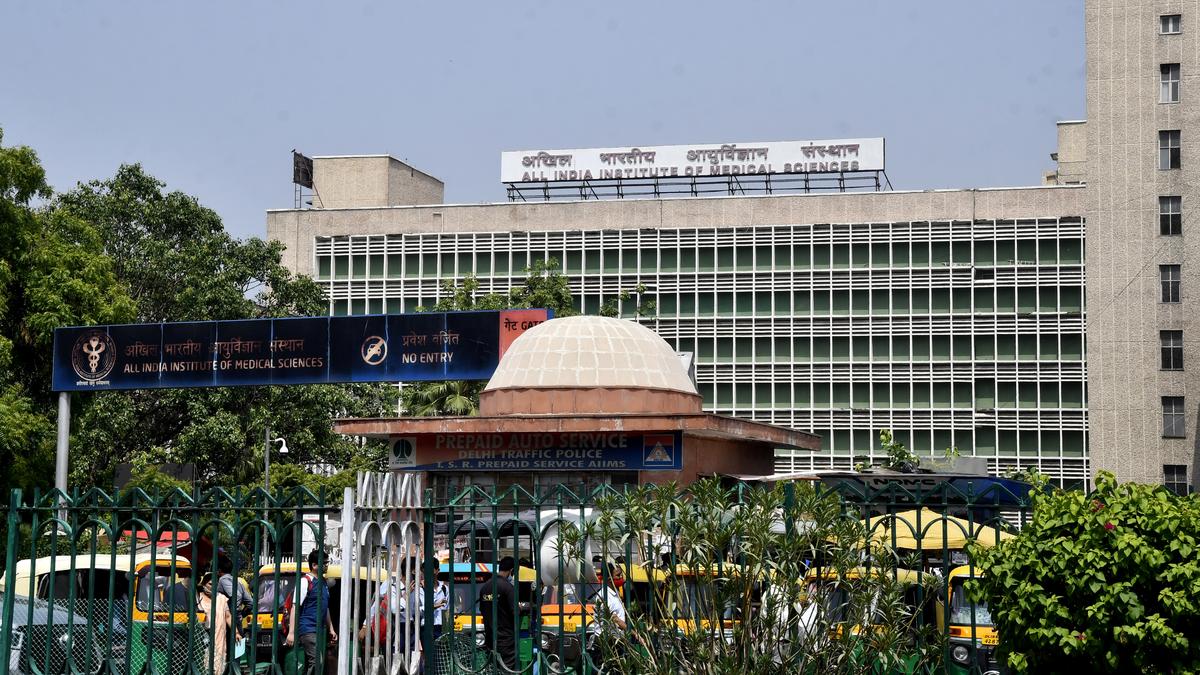
A view of All India Institute of Medical Sciences (AIIMS), in New Delhi. File.
| Photo Credit: Sushil Kumar Verma
Doctors at the All India Institute of Medical Sciences (AIIMS) Delhi have successfully operated and saved the life of a 17-year-old boy (the identity of the patient has been withheld), who had a ‘parasitic’ twin, a fully developed lower limb attached to his abdomen since birth. This is an extremely rare anomaly, according to doctors.
The boy came to the AIIMS in the last week of January. In a multi-department intervention, doctors undertook extensive pre-surgery investigations and then performed a two-and-a-half-hour long operation on the boy, separating the limb, which had adequate blood supply.
Speaking at a press conference on Tuesday, Asuri Krishna, Chief Surgeon for the procedure, said that conjoined twins are very rare, occurring in about 1 in 50,000 to 100,000 births, but sometimes, one twin doesn’t fully develop, leading to what’s called an asymmetrical or ‘parasitic’ twin.
In these cases, one twin (the ‘autosite’) is more developed, while the other (the ‘parasite’) depends on the autosite for survival. These cases are extremely rare and can vary widely in how they appear. Till date, only 40 such cases have been reported in medical literature globally.
Dr. Krishna said this case was unique because the ‘parasitic’ twin was attached and had been growing with the boy. “Since birth, he has lived with this extra limb, which belonged to his underdeveloped twin. The limb grew as he grew. Surprisingly, the patient could feel touch, pain, and temperature in the parasitic limb. He occasionally felt a dull ache in his abdomen and flank but otherwise had normal bowel and bladder function, ate regularly, and had no other major health issues,’’ Dr. Krishna said.
The boy faced significant challenges due to his condition and had dropped out of school in Class 8 because of social stigma.
At AIIMS, a team of specialists, including general surgeons, radiologists, plastic surgeons, and anesthesiologists evaluated him. A CT angiography to assess the blood supply to the ‘parasitic’ limb found that it was supplied by a branch of the internal mammary artery, which usually supplies the chest wall. This made the case more challenging. Additionally, a large cystic mass was also found in his abdomen during the CT scan. After thorough preparation and discussion, the patient’s surgery was scheduled for February 8.
The surgery was complex and involved two main parts. The first part involved removing the ‘parasitic’ limb. The surgeons made a circular incision around the base of the limb, where it was attached to the patient’s chest. They carefully cut through the skin and tissue, identified and tied off the blood vessels supplying the limb, and separated the bony attachment.
The second part of the surgery involved removing the large cystic mass in the patient’s abdomen. The surgeons made a midline incision to access the abdomen and carefully separated the mass, which was stuck to the abdominal wall, bowel, and liver. Once freed, the mass was completely removed.
During this part of the surgery, it was discovered that the boy’s bladder extended unusually high, up to the belly button. This part of the bladder was carefully tied off and divided.
A drain was placed in the area where the mass had been, and the abdomen was closed with sutures.
The boy recovered quickly after the surgery and was able to eat food on the first day, and the drain was removed on the third day. His vital signs remained stable, and he was discharged on the fourth day, a release by AIIMS Delhi said.
Published – February 25, 2025 06:10 pm IST