Just before daybreak on March 2, two police SUVs darted around the hamlet of Teliyabas in Raghunathgarh village of Alwar district in Rajasthan. The police from Naugaon, about 5 kilometres away, were chasing a dot on a map. The dot, moving rapidly, represented the location of a suspected cyber fraudster. A cyber cell embedded in the district headquarters of Alwar police had sent local police a tip off on the location of a smartphone involved in a scam.
The police’s pursuit of the dot brought them to the door of Razida and Imran Khan, 26 and 27 years old. Not yet fully awake, Razida opened the door to their single room home, one in a larger structure of five rooms, where the extended family lives. A policeman allegedly barged in and dragged the couple out, climbing on top of both the cots in the room to roughly look through the couple’s storage unit above the bed.
No female officer was present. The officer found no phone and began questioning Imran, who people in the neighbourhood say is a labourer. The police took Imran out to their cars, asked whether he had a particular smartphone on him. When he said he didn’t, they let him go.
When the couple came back, they found Alisba — their one-month-old daughter — lying motionless in her blanket, on the cot the policeman had climbed on to. They realised she was dead. “We realised that the policeman had stepped on her when he climbed on to the cot,” says Imran.
Mewat as a hub
Teliyabas, which is a part of the Mewat region where the three States of Rajasthan, Haryana, and Uttar Pradesh meet, is among a belt of villages that is hotspot for cyber criminals, or as the locals call them — cyber thuggees . Over 26,000 cybercrime cases have been filed in just Alwar district, many of them against men in their twenties. The village, with a population of a little over 3,000 as per the 2011 census, is ringed by the Aravali hills and surrounded by rolling fields of wheat and mustard.
On March 16 morning, Nasru Khan, 77, a former Minister with the Congress party and currently a Bharatiya Janata Party (BJP) member, drives from Alwar to Teliyabas, 35 km away, picking up Tahir, an influential maulana in Raghunathgarh village, along the way. Like Alisba’s parents, Nasru and Tahir are from the Meo community, traditionally cattle-raisers. As soon as word of the incident reached him, the former Minister said he raced to the Superintendent of Police’s office, where Razida and Imran had arrived, holding Alisba’s body. Other villagers came in support making sure that a first information report (FIR) was filed citing the Bharatiya Nyaya Sanhita section 103(1) for murder.
“Every single day the police has been doing raids,” Nasru says in his car, on the way to the village again. “They operate like thugs.”
Tahir is more emphatic: “There’s no place where the terror of the police is comparable to this.” On the drive to the couple’s home, the houses are unpainted and exposed-brick structures. The hum of Naugaon, whose police were involved in the incident, seems distant.
One in five students have left school in Alwar, according to a data compiled by the Rajasthan government’s Directorate of Economics and Statistics. Nuh, a neighbouring district in Haryana previously known as Mewat, was rated as India’s most backward in a Niti Aayog report in 2018.
People protest
Near the house, a demonstration is in progress. About 40 people — male children and men around the age of the couple — are holding placards, demanding justice for the infant’s death. Arshad, one of Imran’s three brothers, guides a group into the family’s house. A block of incense burns in front of a broken boundary wall.
The police from Naugaon station is absent and has not been to the village since the death of the infant. By this time, six policemen, including the station house officer, have been sent to the lines in Alwar, but have not been suspended.
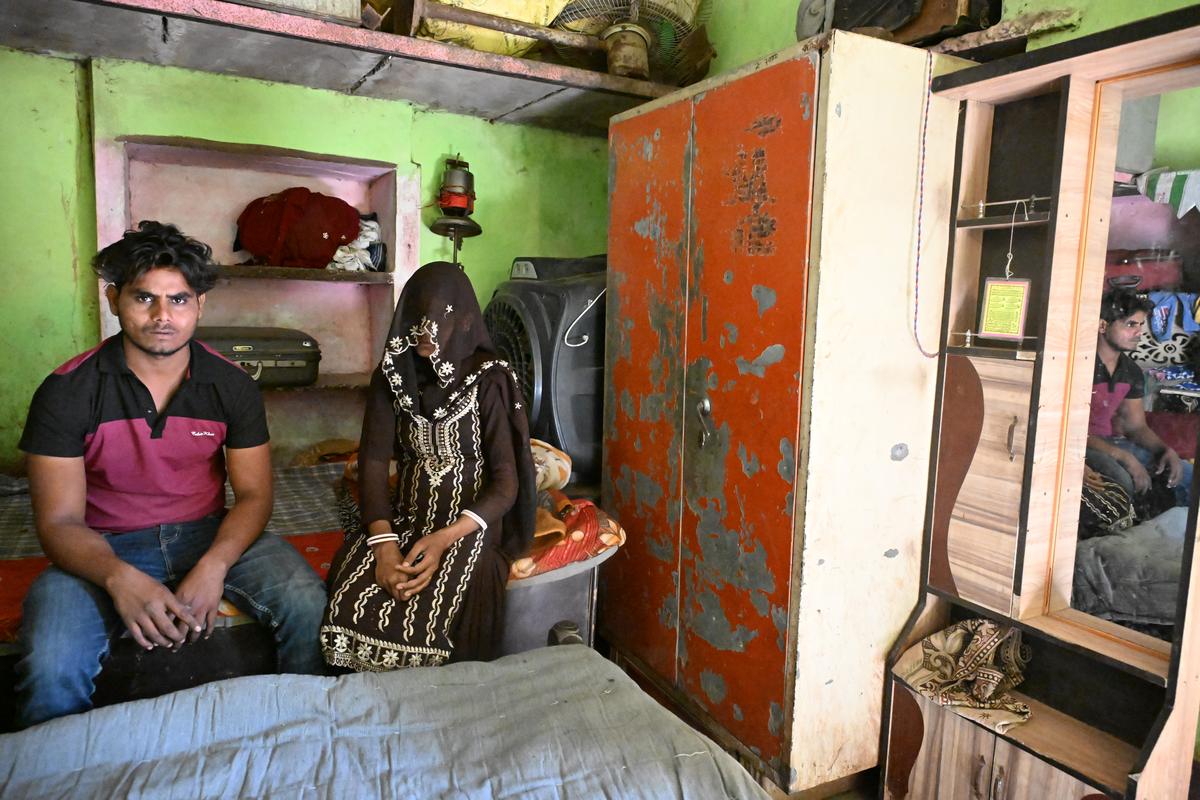
Imran and Razida Khan in their room at Teliyabas hamlet, as they mourn the death of their child.
| Photo Credit:
SUSHIL KUMAR VERMA
Imran narrates the incident blow for blow, as Razida lets out an occasional weak sob. She couldn’t get out of bed for days, her husband says. Their home has become the site of protest and national attention. Brinda Karat, a member of the polit bureau of the Communist Party of India (Marxist), came and donated ₹1 lakh to the family. Mediapersons, from the local, national and international press stream in.
Even as the tragedy weighs on the family, the maulana and Arshad are keen on establishing that they are not cyber frauds. “Pinch these calluses,” Arshad insists, as Imran presents his worn hands. “Are these the hands of a cyber thuggee.
Outside, two police officers — assigned from a different police station after an uproar over the non-suspension of the raiding party — are trying to get a signature on a witness statement from the family and some neighbours. The crowd refuses, saying they didn’t recognise some of the names on the witness list.
“They tried to get them to sign a blank paper before the FIR was registered in exchange for ₹8-10 lakh,” Nasru says, referring to police officers who were initially looking into the case. This was before the national spotlight on the case. As the police leave, maulana Tahir insists again, a little away from the crowd, “Everybody does cyberthuggee in this area.”
Cyber ‘thuggees’
In Raghunathgarh colony, which is a stone’s throw away from Teliyabas, a gathering crowd discusses the issue of cyber thuggee, and frequently uses the term “OLX wala kaam,” referring to a scam on the second-hand product listing platform. Small amounts of advance money are demanded to be transferred until the victim realises they have been scammed.
Several villagers talk about the way cybercrime is dealt with: “The police get a complaint, catch someone, and drive them up the road to the police station. On the way, the scammer offers a bribe. The police take it and let him go. There is no action in the case,” says Nepal Singh.
“Those boys are not involved in this kind of work,” Singh adds, referring to Imran and his brothers. “Three of them break rocks all day.”
Another resident is summoned when the subject of people who admitted to engaging in cyber thuggee comes up. “It’s all unemployment,” the man in his twenties says, not giving out his name, nor confirming if he was talking from personal experience. “If the police caught the scammers and actually sent them to jail, would anyone continue to do this work?”
Tracking hub
At Alwar’s cyber crime police station, 50 km away, six plain-clothes officers with rolled up sleeves are typing away at laptops at two long tables. The door is open to let the breeze in, and laptops sit on cooling stands.
An officer switches between a Google and Microsoft inbox, opening case reports and sending brief replies. He copies an Internet protocol address from a cybercrime report and pastes the string of numbers in a website. The location shows up as Fremont, California. “They’re using a VPN,” he say, sighing, referring to a tool often used — both by legally-run businesses and by criminals — to mask an Internet user’s location.
After swatting away two parties of complainants — “It’s just not possible that a bank account was made in your son’s name without his cooperation! Go talk to the bank.” — Ajay Singh, the head moharrir (second-in-command) of the station, describes the flavours of cyber fraud scams that have been in vogue over the last few months.
“We started with OLX scams,” he says. After that, there were sextortion cases, where a scamster would capture a screen recording of a male victim answering a video call with a naked woman, and threaten to release the video to their friends and family. Lately, he says, there’s a proliferation of trading scams, where scammers convince victims that they will invest their money for unrealistic returns. “They even do something as simple as calling a cement vendor, giving him a fake order, and then texting to say they have transferred say, ₹10,000 accidentally instead of ₹1,000, asking them to return the ₹9,000. The vendor ends up sending the goods and returning the ‘extra’ money,” Singh says.
At a polished wood-panelled office in Alwar, a senior police administrator says Alwar has been witnessing a crackdown on cybercriminals. He says complaints on the 1930 helpline — which the government is currently promoting with audio messages before phone calls — for Alwar had reduced by a third in the past year. “We are even cracking down on neighbouring State police involved in such frauds,” he says. What about the police accepting bribes and letting fraudsters go? “If anyone has an allegation, they can come forward to the Anti-Corruption Bureau,” he adds.
The officer claims that much of the mobilisation and media coverage of Alsiba’s death was orchestrated, a part of the backlash to the police crackdown under way. “The autopsy report says that there was no injury visible on the girl,” the officer says.
Government promises
Sunil Prasad Sharma, Deputy Superintendent of Police in Ramgarh, under whose jurisdiction the incident occurred, says, “The investigation is under way,” and that the autopsy “can be shared after the report is in”.
Atul Sahu, Additional Superintendent of Police in Bhiwadi, the investigating officer, does not answer The Hindu’s calls. Dr. Manoj Kumar, who performed Alsiba’s autopsy, declines sharing details of the case.
On March 17, Rajasthan’s Agriculture Minister Kirodi Lal Meena addressed Teliyabas’s villagers. At an empty ground covered with carpets and a tent for the visiting dignitary, Mr. Meena promised, “If the investigation into this matter is not done properly, we will go all the way to New Delhi.”
After Mr. Meena’s assurances, the protest tent and the preparations on the ground are torn down, and nearly everyone has gone home. Imran sits slouching at a table, gazing into the distance, and letting his family answer questions. All Imran says is, “The support from the villagers and the media is giving us strength. ”A loudspeaker trills in, announcing the Asr, the prayer before sunset. It’s just 4 p.m., but the sun is already retreating into the hills. Everyone disperses to pray. There are still a couple of hours left before the Ramzan fast can be broken.
India’s national cybercrime helpline is 1930.
aroon.deep@thehindu.co.in
Edited by Sunalini Mathew
Published – March 22, 2025 08:45 pm IST