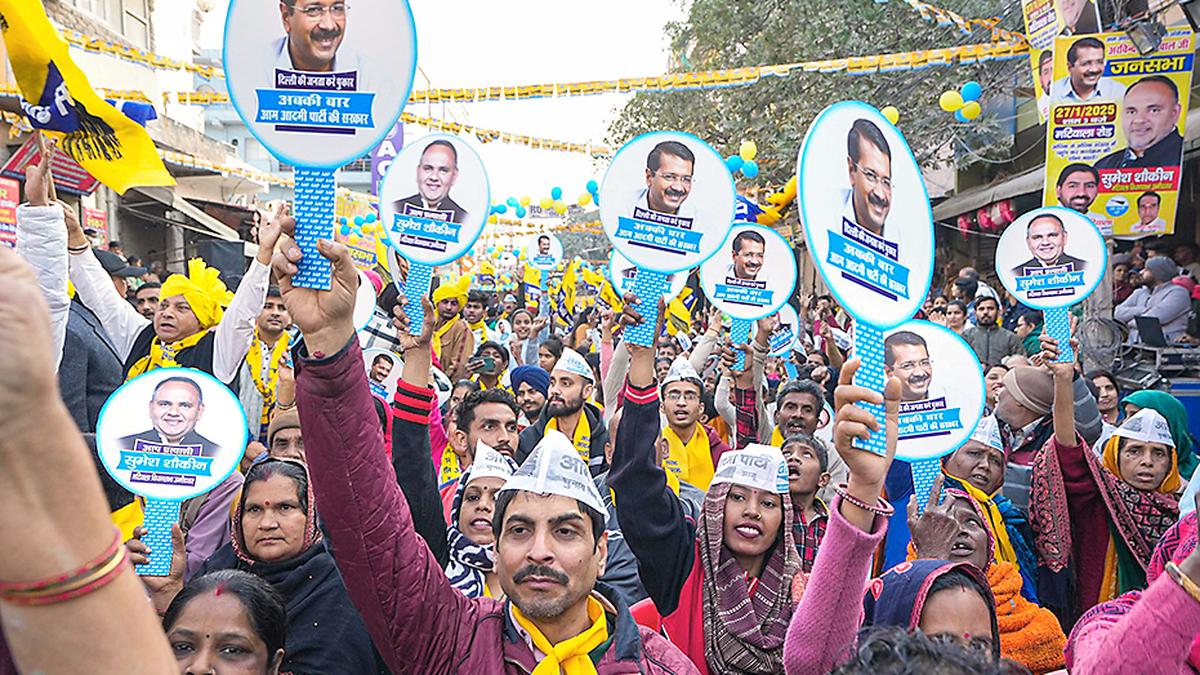
Aam Aadmi Party (AAP) supporters during the election rally of party cabdidate of Matiala Assembly Constituency Sumesh Shokeen ahead of Delhi Assembly Elections
| Photo Credit: X/@AAP
A section of middle-class voters, who in the past have voted for the BJP in the Lok Sabha election and for the AAP in the Assembly election, voting for the BJP this time, was one of the main reasons for the AAP’s loss, a senior AAP leader told The Hindu.
Also Read | BJP’s USP in Delhi: Micro-level outreach programmes, door-to-door campaigns
The party’s focus will now be on the Punjab Assembly election and leaders from Delhi will be extensively part of it as they have more time at hand now. “There will be restructuring in the Delhi unit also to accommodate many senior leaders and many of them will also be focusing more on Punjab. In the past also, as soon as the Delhi election was over we shifted our focus to Punjab and we will be doing the same this time too,” the leader said.
In 2014, the BJP had won all seven Lok Sabha seats, but 10 months later, the AAP had won 67 out of 70 seats in the Delhi Assembly election in 2015. Similarly, in 2019, the BJP again won all seven Lok Sabha seats, but months later, the AAP won 62 out of 70 seats in the Assembly election in 2020.
The leader said that the party is yet to conduct a booth-level review, but on the face of it, of the about 10% vote share they lost this time compared to 2020, 6-7% is the party’s middle-class voters, who voted for the BJP this time. “These are people who are used to pressing phool ka button during Lok Sabha election, but used to vote for us during Assembly, as we gave them better benefits in Delhi,” he said.
Also Read | We failed to get anti-BJP votes of Dalits, minorities: Delhi Congress chief
The leader also said that the party had done close-door meetings with middle-class voters in December and early January, before the nomination, but the RSS did a round of close door meetings towards the end of January and early February.
“In retrospect, we should also have done close door meetings closer to the polling and we could have won many of the seats where we won by 2000-3000 votes. We didn’t see that shift of middle class voters towards the BJP happening after the Union Budget (on February 1), where the tax cut for the middle class was announced by the BJP,” the leader said.
The Delhi election was on February 5 and the last day for campaiging was on February 3, giving the AAP very less time to react to the Budget, he added.
In the run up to the election, trying to woo the middle-class, AAP chief Arvind Kejriwal had on January 22 demanded the Union government to dedicate the budget for the middle-class and even made seven demands for the middle-class in the budget.
“We also lost about 2% of our voters from slums due to the muscle power the BJP used this time, apart from the money they pump in every time, as it created a fear in the minds of slum dwellers that if we do not vote for the BJP after taking the money, there will be consequences,” the leader said.
The leader also said that though from the vote share it might feel that an alliance with the Congress could have helped the AAP, in reality if there was an alliance, it could have given more ammo to the BJP and the move could have backfired. “It is not as easy as looking at the vote share on paper and thinking that if we had the 6% vote share of the Congress we would have won many seats. The politics and the results would have been different we there was an alliance,” he said.
“After being in power for 10 years and despite all these attempts by the BJP to end the AAP, the party still got close to 44% vote share, which is by no means a small feat. People will now rest a little and we will re-group and keep fighting for the people,” the leader said.
Published – February 13, 2025 09:18 am IST